
A new Reels format is everywhere right now: creators perform a series of quick, dramatic hand gestures — borrowed directly from the “summoning hand signs” in Jujutsu Kaisen — then cut on a beat drop to reveal a product, a dish, or a transformation. Brands from cognac labels to science museums have picked it up because it’s visually striking and instantly recognizable to a generation raised on anime.
What’s interesting is that this trend is, almost accidentally, reviving public curiosity about hand gestures as a form of symbolic language — something the Vedic tradition has practiced with real depth for thousands of years, in the form of mudras. This piece separates the two: what the viral trend actually is, what mudras actually are in Vedic and astrological practice, and where the genuine overlap (and the very real differences) lie.
What the Viral Hand-Sign Trend Actually Is
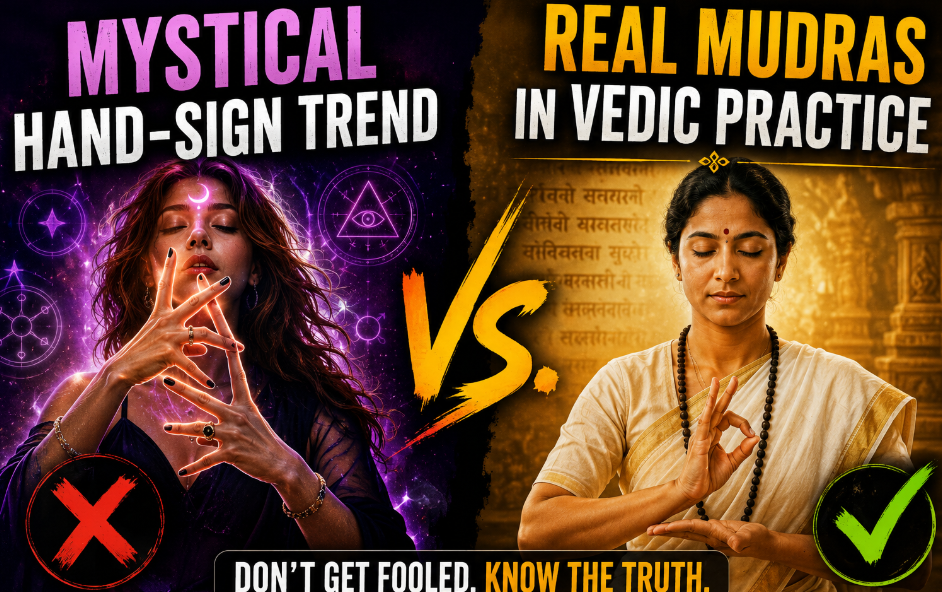
The anime hand-sign trend has no symbolic or energetic claim behind it — it’s a stylized performance format. The mechanics are simple: perform a sequence of hand movements, cut sharply on a musical beat, and reveal something at the peak of the gesture. The entire function of the gesture sequence is dramatic timing, not meaning. There’s no claim that a particular gesture does anything; the gestures exist purely to build anticipation before the reveal.
This matters because it’s the opposite design principle of a real mudra, where the specific shape of the hand and the specific fingers involved are considered central to its purpose, not just a performance beat.
Free Astrology + Instagram Reading: Find Your Cosmic Blueprint in 30 Seconds
What a Mudra Actually Is
A mudra is a specific, codified hand position used in yoga, meditation, classical dance, and ritual worship across Vedic tradition. Unlike the anime trend, where any hand movement works as long as it looks dramatic, a mudra’s power (in traditional understanding) comes precisely from its exact form — which fingers touch which, and the resulting flow of prana (life energy) it’s believed to direct through the body.
Mudras appear across several distinct contexts in Indian tradition: hasta mudras in classical dance (Bharatanatyam, Odissi) that convey specific narrative meanings; yogic mudras used during meditation and pranayama to influence energy flow; and puja mudras used by priests during ritual worship to represent offerings, blessings, or the presence of a deity.
Mudras in a Vedic Astrology Context
Because Vedic astrology and yogic practice share the same philosophical root system, several mudras are specifically recommended in astrological remedial practice, tied to planetary energies. This is where the overlap with astrology becomes concrete rather than symbolic:
- Surya Mudra — touching the ring finger to the base of the thumb, associated with the Sun and used to strengthen willpower and vitality, often recommended for a weak Sun in a birth chart.
- Prithvi Mudra — thumb and ring finger together, associated with Earth-element balancing, sometimes recommended alongside Mercury or Venus-related remedies.
- Vayu Mudra — index finger folded under the thumb, associated with Air element and Rahu-related restlessness in some traditions.
- Gyan Mudra — thumb and index finger touching, the most widely recognized meditation mudra, associated with clarity and Jupiter’s expansive, wisdom-oriented energy.
Three Real Differences Between the Trend and the Tradition
1. Intent
The Reels trend exists to create a satisfying visual beat before a reveal. A mudra exists because the practitioner believes the specific hand shape has an effect on energy flow, breath, or ritual meaning. One is entertainment engineering; the other is a claimed energetic practice.
2. Precision
In the viral trend, close enough is good enough — the exact finger position doesn’t change the outcome, only the drama does. In traditional mudra practice, precision matters: a slightly different finger position is often considered a different mudra entirely, with a different intended effect.
3. Duration
The anime trend is a one-to-three-second visual flourish. Mudras, particularly in meditation and pranayama practice, are traditionally held for extended periods — often several minutes — because the believed effect is cumulative, not immediate.
A viral hand gesture is designed to be seen for one second. A real mudra is designed to be held long enough that you stop noticing your hand at all.
Why This Comparison Is Worth Making
It would be easy to dismiss the anime trend as having nothing to do with real mudras, and in terms of underlying claims, that’s true. But the comparison is still useful for a simple reason: the trend has put hand gestures back into the cultural spotlight, and that’s an opening for people who’ve never been exposed to Vedic hand-gesture science to actually learn what real mudras are for, rather than treating them as just another aesthetic.
Several astrology and wellness creators have already started using this cultural moment productively — posting genuine mudra tutorials captioned as “the real version” of the trending format, redirecting curious viewers from the anime aesthetic toward an explanation of what Surya Mudra or Gyan Mudra is actually believed to do. This is a healthy way to use a viral moment: not to imitate it directly, but to use the attention it generates as a doorway into something with real depth behind it.
Where the Trend Format Actually Works Well as Education
A handful of astrology and yoga creators have found a genuinely effective format here: they open with the trending anime-style gesture sequence to catch attention through the algorithm, then transition mid-video into the real mudra, explicitly naming the contrast. This works because it respects both audiences — viewers who came for the trend get a satisfying reveal, and viewers who stay get accurate information about a genuine practice, rather than a blurred, misleading version of it. It’s a useful model for any creator trying to introduce Vedic concepts to an audience that primarily discovers content through trending formats rather than search.
How to Try a Real Mudra Practice (Without Turning It Into a Gimmick)
- Pick one mudra tied to a planetary energy you want to work with — Gyan Mudra for clarity and focus is the easiest starting point for beginners.
- Hold it during a seated meditation or pranayama session for at least five to ten minutes, rather than a quick flash for the camera.
- Pay attention to breath alongside hand position — in traditional practice, the two are meant to work together, not separately.
- If you want to film it for content, let the stillness be the point rather than a dramatic cut — a slow, steady hold communicates the actual practice far more honestly than a fast-cut reveal.
Frequently Asked Questions
Are mudras scientifically proven to work?
Mudras are a traditional practice rooted in yogic and Ayurvedic philosophy rather than clinical science. Some associated benefits, like the calming effect of slow, deliberate hand positioning during meditation, overlap with general mindfulness research, but the specific energetic claims tied to individual mudras remain a matter of tradition and belief rather than scientific proof.
Can mudras replace astrological remedies like gemstones or mantras?
Mudras are typically considered a complementary practice alongside other traditional remedies, not a replacement. Serious practitioners generally use them as one part of a broader remedial approach that might also include mantra japa, fasting, or gemstone therapy, depending on individual guidance.
Is it disrespectful to use mudra-like gestures for a viral trend?
Context matters. Anime-inspired hand-sign trends aren’t derived from or referencing mudras at all, so there’s no direct disrespect in the trend itself. It becomes a concern only if creators mislabel entertainment gestures as authentic spiritual mudras, which can spread inaccurate information about the tradition.
How long does it take to learn basic mudra practice?
Learning the correct hand position for a basic mudra like Gyan Mudra takes only a few minutes. Developing a consistent practice where you can comfortably hold it during extended meditation, and genuinely integrate it into a regular routine, typically takes a few weeks of practice.

Astrology has always fascinated me, and that’s why I founded Astrofite.com. I’m Pratiksha, and I believe in the power of cosmic energies to guide us toward a better life. Through Astrofite, I aim to bring clarity and spiritual growth to those seeking answers beyond the ordinary.