
If you’ve ever scrolled through a spiritual blog or walked into a metaphysical shop, you’ve probably been hit with this overwhelming realization: there are so many ways to seek guidance. Tarot cards. Birth charts. Life path numbers. Angel numbers. Moon signs. Major arcana. Pythagorean numerology.
Where do you even start?
The truth is, tarot, astrology, and numerology are not competing systems — they’re three distinct languages for exploring the same deep territory: your inner world. But each one speaks differently. And depending on how your mind works, what questions you’re asking, and how you prefer to receive insight, one of these tools is probably a better fit for you than the others.
Let’s break all three down clearly, honestly, and without the mystical jargon overload.
What Is Astrology?
Astrology is the study of how the positions of celestial bodies — planets, the Sun, the Moon — correspond to personality, life events, and cycles. It’s built on thousands of years of observation across multiple cultures, from Vedic India to ancient Greece to Mesopotamia.
At its core, astrology gives you a map. Your natal birth chart is a snapshot of the sky at the exact moment you were born. It shows where every planet was placed, which zodiac signs and houses they occupied, and how they interact with each other. From that map, an astrologer can describe your personality patterns, the themes you’ll encounter in relationships or career, and the timing of significant life chapters.
What Astrology Is Good At
- Understanding your baseline personality and why you are the way you are
- Identifying cyclical themes and timing — when to act, when to wait
- Relationship compatibility (synastry and composite charts)
- Career and life purpose guidance based on planetary placements
- Understanding long-term life phases through transits and progressions
What Astrology Requires
You need your exact birth date, time, and location. The more precise, the more accurate. Astrology rewards people who enjoy complexity — there are hundreds of variables in any chart. It’s a deep system that can take years to fully learn, though basic sun-sign astrology is accessible to anyone.
Uranus in Gemini 2026 – How This Rare Transit Will Change Your Life
What Is Tarot?
Tarot is a deck of 78 cards — 22 Major Arcana and 56 Minor Arcana — each carrying a specific symbolic meaning. Originally created as playing cards in 15th-century Europe, they were adopted for divination by esoteric traditions in the 18th century and have been a tool for self-reflection ever since.
A tarot reading involves drawing cards in response to a question or situation, then interpreting the symbols, imagery, and position of each card in the context of that question. A skilled reader — or an honest beginner — can use tarot to surface unconscious feelings, explore options, and receive clarity in moments of confusion.
What Tarot Is Good At
- Getting immediate insight on a specific question or situation
- Revealing hidden emotions, fears, or motivations you may not want to admit
- Exploring choices and probable outcomes without making decisions for you
- Daily reflection and journaling — many people do a one-card pull each morning
- Short-term guidance on relationships, career choices, and personal crossroads
What Tarot Requires
A willingness to be honest with yourself. Tarot doesn’t lie — but it does reflect. If you’re resistant to self-inquiry or want definitive yes/no answers rather than nuanced insight, tarot can feel frustrating. But if you’re open to using it as a mirror, it’s remarkably effective. You don’t need any birth information — just a question and an open mind.
What Is Numerology?
Numerology is the study of the mystical relationship between numbers and life events or personality traits. It’s based on the idea — found in Pythagorean mathematics, Kabbalistic tradition, and various ancient systems — that numbers carry vibration and meaning beyond their mathematical value.
In practice, numerology assigns numerical values to your birth date and the letters in your name. From these, it derives key numbers: your Life Path Number, Expression Number, Soul Urge Number, and others — each describing a different dimension of your nature, purpose, and destiny.
What Numerology Is Good At
- Quickly revealing your core life theme or soul mission through your Life Path Number
- Understanding recurring patterns in your life — why certain themes keep showing up
- Personal Year cycles — understanding what energy each calendar year carries for you
- Name analysis — numerologists often advise on name changes for business or personal branding
- Simple, accessible insights that don’t require deep study to grasp
What Numerology Requires
Just your full birth name and date of birth. Numerology is perhaps the most accessible of the three systems for beginners — the calculations are simple, and the insights can be surprisingly profound. However, it’s less dynamic than astrology (which changes by the minute) and less emotionally granular than tarot.
Tarot vs Astrology vs Numerology — A Direct Comparison
Here’s an honest side-by-side look at all three:
Complexity: Astrology is the most complex (hundreds of chart variables). Tarot is moderately complex (78 cards × positions × spreads). Numerology is the simplest to learn and apply.
Information needed: Astrology requires exact birth data. Numerology needs your name and birthdate. Tarot needs nothing — just a question.
Best for timing: Astrology wins here — transits and progressions offer incredibly precise timing guidance. Numerology provides yearly cycles. Tarot offers present-moment snapshots.
Best for self-reflection: Tarot is the most intimate and emotionally honest. It surfaces what’s happening below the surface right now.
Best for beginners: Numerology — you can get meaningful insights within minutes. Tarot is also beginner-friendly if you enjoy intuitive work. Astrology has the steepest learning curve.
Best for life purpose: Both astrology (through your natal chart) and numerology (through your Life Path and Expression numbers) excel at this. Tarot can reflect it but not map it.
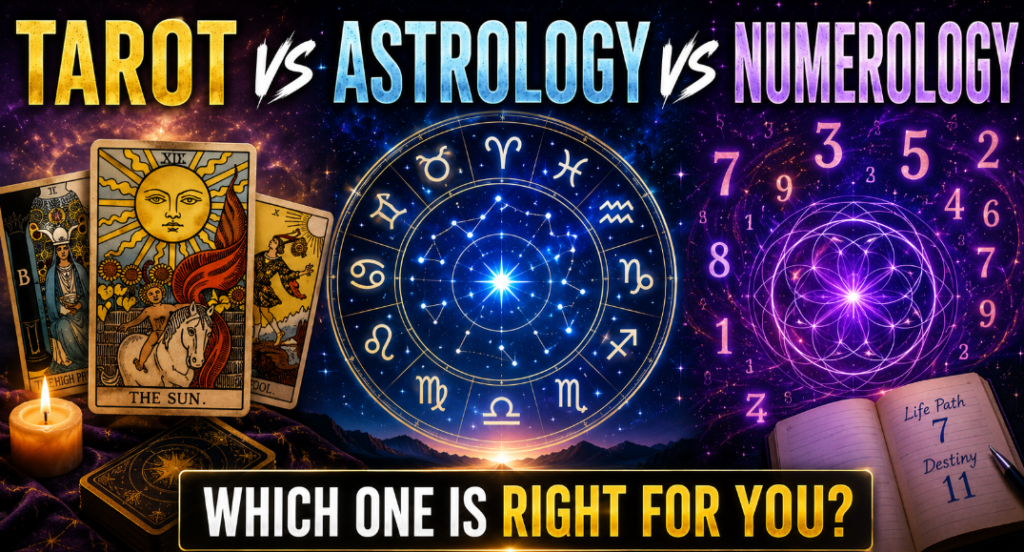
Which One Is Right for You?
Rather than declaring a winner, here’s a simple self-quiz to figure out your best match:
Choose Astrology If…
- You love depth, complexity, and systems thinking
- You want to understand the timing of your life, not just its themes
- You’re interested in how cosmic cycles connect to personal experience
- You enjoy studying — birth charts take time to learn to read
- You want a permanent, evolving tool that grows with you for decades
Choose Tarot If…
- You’re asking a specific question and need clarity right now
- You’re naturally intuitive and respond to symbols and imagery
- You want a daily practice that keeps you honest with yourself
- You enjoy the creative and artistic dimension of spiritual tools
- You’d rather explore possibilities than receive structured predictions
Choose Numerology If…
- You want quick, meaningful insights without a steep learning curve
- You’re a logical thinker who prefers patterns over metaphor
- You want to understand your core life purpose in a simple framework
- You’re exploring spirituality for the first time and want an entry point
- You’re interested in understanding why certain years feel more significant than others
Can You Combine All Three?
Absolutely — and many serious spiritual practitioners do exactly that. Astrology gives you the long-term map. Tarot gives you the present-moment mirror. Numerology gives you the core vibration beneath it all. Used together, they create a remarkably complete picture.
For example: you might use your Life Path Number (numerology) to understand your soul’s mission, your natal chart (astrology) to see how that mission plays out through your personality and life timing, and a tarot spread (tarot) to navigate a specific decision or emotional situation in real time.
They don’t compete. They layer.
A Note on Skepticism — And Why It Doesn’t Matter
If you’re approaching this with healthy skepticism, that’s actually a sign of good intellectual hygiene. The most honest practitioners of all three systems will tell you the same thing: these tools are not fortune-telling machines. They’re frameworks for self-reflection. Astrology doesn’t cause events — it tracks patterns. Tarot doesn’t predict the future — it reflects the present. Numerology doesn’t determine your fate — it describes tendencies.
What makes them valuable is the same thing that makes therapy, journaling, or meditation valuable: they create structured space for you to examine your life with more depth and intention. The insight always comes from you. The tool just gives it a language.
Final Thoughts
Tarot, astrology, and numerology have each survived thousands of years not because they’re magic, but because they work — when you engage with them honestly. Whether you’re drawn to the symbolic richness of a tarot deck, the cosmic precision of a birth chart, or the elegant simplicity of numerology, the right tool is the one you’ll actually use.
The best starting point? Pick the one that makes you the most curious right now. Explore it with an open mind for 30 days. See what it reveals.
At AstroFite.com, we offer resources across all three systems — beginner guides, readings, and tools to help you find what resonates. Explore, question, and trust your own inner knowing along the way.

Pratiksha Thakare is a Vedic astrology writer and spiritual researcher with deep study in Jyotish, numerology, and Hindu philosophy. She writes to make ancient wisdom simple and accessible for modern Indian readers.