
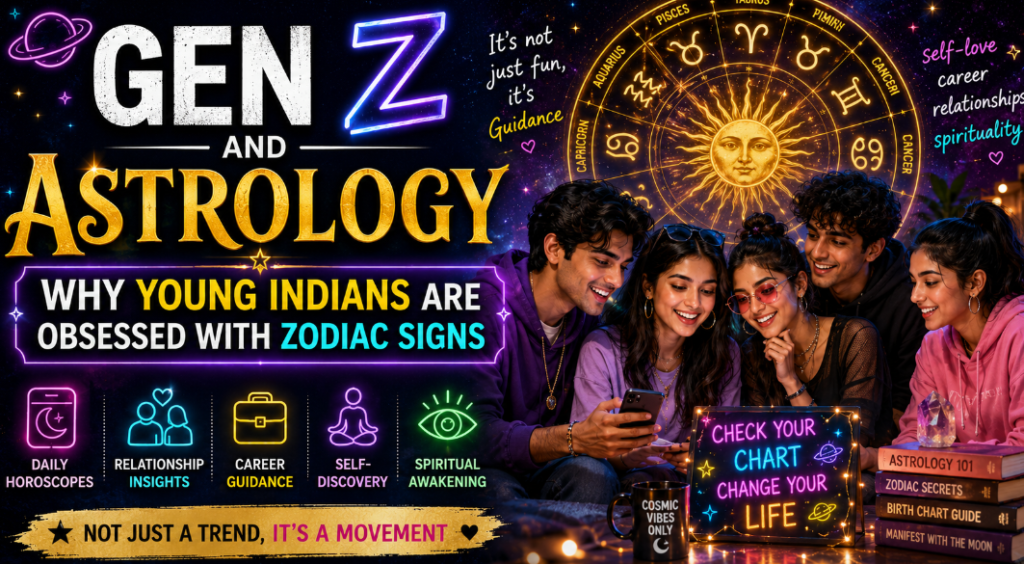
Open Instagram. Scroll through Twitter. Join any college WhatsApp group. Within five minutes, you will find someone asking, “What’s your sun sign?” or declaring “That’s so Scorpio of you.” Astrology has quietly become the unofficial language of Gen Z in India — and it is not showing any signs of slowing down.
Whether you are a die-hard believer or a sceptic who rolls your eyes, you cannot deny the numbers. Astrology apps like AstroSage, Astroyogi, and Bejan Daruwalla’s platform have seen a massive surge in downloads since 2020. Meme pages dedicated to zodiac personalities get millions of likes. And some of India’s most popular Instagram reels? Astrology content.
So what exactly is happening here? Why is a generation that grew up with science, smartphones, and start-up culture turning to the stars for answers?
🔮 Let’s find out — and yes, your zodiac sign might actually have something to do with it.
The Numbers Don’t Lie
According to a 2023 YouGov survey, nearly 45% of Indians aged 18 to 35 said they check their horoscope at least once a week. The Google Trends data for searches like “my zodiac sign,” “astrology 2026,” and “zodiac compatibility” has consistently risen year on year since 2019.
Apps like Nebula and Co-Star — which became global phenomena — have Indian user bases growing at 30–40% annually. The pandemic played a big role in this, but the trend has clearly outlasted it.
This is not your grandmother’s astrology. Gen Z has remixed it, memed it, and made it deeply personal.
Tarot vs Astrology vs Numerology – Which One Is Right for You?
Social Media Made Astrology Cool Again
Let’s be honest — astrology was always around in India. Every household has that one aunt who checks the kundali before any big decision. But for Gen Z, the entry point was different: it was memes.
Zodiac meme pages on Instagram started posting relatable content — “Virgos will reorganise their bedroom at 2 AM” or “Geminis have three different personalities before breakfast” — and people went crazy. Why? Because it was funny, it was shareable, and it gave people a framework to understand themselves and their friends.
Astrology content creators like Astro Speak, AstroFite, and dozens of regional creators in Hindi, Tamil, and Telugu have built massive communities just by making astrology feel modern, visual, and conversational.
💡 Key insight: Astrology became a content format before it became a belief system for many young Indians.
The Psychology Behind It — Why Gen Z Needs Astrology
Let us go a little deeper than the memes. There is a very real psychological reason why astrology resonates with young people, especially in uncertain times.
1. Identity in a Confusing World
Gen Z is the most diverse and yet most confused generation when it comes to identity. They are navigating career choices, relationships, mental health, and social expectations — all while being constantly watched on social media. Astrology offers a shortcut to self-understanding. Saying “I’m a Capricorn” instantly communicates something about your ambition, your seriousness, your fear of failure.
It is personality psychology made poetic. The Myers-Briggs is for corporate offices; zodiac signs are for Instagram stories.
2. Control in Uncertainty
Post-pandemic India has been defined by anxiety — job market pressure, climate stress, social uncertainty. Astrology gives people a narrative framework. Knowing that Mercury is in retrograde explains why your laptop crashed and your ex texted you on the same day. It is comforting to have a cosmic reason for chaos.
Psychologists call this “illusory control” — the feeling that the universe follows a pattern and you can read it if you just know how.
3. Community and Belonging
“Oh you’re a Pisces? Me too!” is one of the fastest icebreakers in Gen Z culture. Astrology has become a social language — a way to bond, tease, and connect. In a generation that struggles with loneliness despite being constantly connected, sharing a zodiac sign feels like an instant membership to a club.
The Indian Cultural Connection
Here is something Western media rarely talks about: Indian Gen Z has a unique relationship with astrology because it is genuinely woven into the culture. Unlike the West where astrology is mostly sun-sign based (“I’m a Leo”), Indian astrology — Vedic Jyotish — is far more complex and has been a part of daily life for thousands of years.
Naming ceremonies, marriage matches, muhurta for starting a business, wearing gemstones based on your birth chart — these are not superstitions for millions of Indian families; they are lived reality. Gen Z grew up watching their parents check the panchang before a big decision. That comfort with astrology was already in the cultural DNA.
What changed is the medium. Gen Z is accessing the same wisdom but through apps, reels, and podcasts instead of going to a Jyotishi in a traditional setting.
🪐 Vedic astrology is not just entertainment for many young Indians — it’s ancestral knowledge repackaged for the smartphone generation.
Astrology as Mental Health Tool
This might surprise you, but many mental health professionals in India have noted that astrology serves as a low-barrier entry point to self-reflection. When someone reads that their Virgo placements explain their overthinking tendencies, it opens a door to understanding themselves — even if the mechanism is fictional.
Several astrology-informed journaling trends have exploded on YouTube and Instagram. “New Moon intentions setting” and “Full Moon release rituals” have become genuine wellness practices for thousands of young urban Indians who might never set foot in a therapist’s office.
Is it science? No. Is it helping people pause, reflect, and feel less alone? Often, yes.
The Business of Belief: India’s Astrology Economy
Let us talk numbers again, because this is where it gets really interesting. India’s astrology market is estimated to be worth over ₹2,000 crore and is growing rapidly. This includes:
- Online astrology consultation platforms (Astrotalk reportedly crossed ₹100 crore in revenue)
- Gemstone and rudraksha e-commerce (Tanishq, Caratlane adding birth-stone collections)
- Astrology content creators earning via brand partnerships, paid subscriptions, and courses
- Astrology apps offering premium birth chart readings
Gen Z is not just consuming astrology — they are monetising it. Dozens of young Indians aged 20-28 have become full-time astrologers, building audiences of lakhs on social media and earning in multiples of what their MBA-holding peers make.
The Criticism — And Why It Doesn’t Slow Things Down
Of course, astrology has its critics. Scientists and rationalists rightly point out that there is no empirical evidence that celestial bodies affect human personality or daily events. The Barnum effect — where people accept vague, general statements as personally accurate — explains much of astrology’s persuasive power.
But here’s the thing: most young Indians who follow astrology know this. They will openly say, “I don’t know if it’s real, but it’s fun and sometimes it just… fits.” They are not replacing medical diagnosis with birth chart readings (mostly). They are using it as a lens, not a law.
💡 Gen Z follows astrology with a playful scepticism — they believe just enough to enjoy it, not so much that it controls their lives.
What This Means for India’s Digital Culture
The astrology boom says something bigger about India’s Gen Z. They are not rejecting modernity — they are blending it with tradition in ways that feel authentic to them. They trust their algorithm and their Ascendant. They DM their crush and check compatibility. They apply for a job and see if Saturn will cooperate.
This is the new Indian identity — plural, curious, and deeply human.
Astrology, at its best, gives them permission to be complex. You are not just your job title or your CGPA. You are a Scorpio rising with a Libra moon trying to navigate a very complicated world.
Final Thoughts
The obsession is not going away. If anything, as astrology apps get smarter, content gets more personalised, and Vedic astrology finds its global audience, this space is going to grow even more. For young Indians, the stars are not just in the sky — they are on their phone screens, in their group chats, and quietly shaping some of the biggest decisions of their lives.
Whether you find that fascinating or frustrating probably depends on your sign.

Pratiksha Thakare is a Vedic astrology writer and spiritual researcher with deep study in Jyotish, numerology, and Hindu philosophy. She writes to make ancient wisdom simple and accessible for modern Indian readers.