
Your hands have been with you since before you were born. They held your first toy, wrote your first letter, and have worked alongside you through every chapter of your life. But according to the ancient science of palmistry — known as Hasta Samudrika Shastra in Sanskrit — your hands contain far more information than meets the eye. They hold the map of your life.
Palmistry is one of the oldest divination systems in the world, with roots in ancient India, China, Mesopotamia, and Egypt. In India, it has been practiced for thousands of years as part of Jyotish Shastra (Vedic astrology), and even today millions of Indians consult palm readers before major life decisions — from marriage and career moves to business ventures.
In this beginner’s guide, we will focus on the five most important lines in palmistry — the ones that every reader looks at first — and explain what they truly reveal about your life, health, relationships, and destiny.
Before You Begin: Which Hand to Read?
This is the first question every beginner asks, and the answer depends on what you want to know.
In Indian palmistry tradition, the non-dominant hand (usually the left hand for right-handed people) represents the potential you were born with — the blueprint written by your karma, family lineage, and soul’s intention. The dominant hand (usually the right) represents how you have used that potential — the life you have actually lived through your choices, habits, and efforts.
Most palmists read both hands and compare them. If your dominant hand shows significant differences from your non-dominant hand, it suggests that your life choices have actively shaped your destiny — for better or worse.
Name Number Numerology – How Your Name Is Secretly Controlling Your Destiny
For a beginner reading, start with your dominant hand for the most accurate reflection of your current life path.
The 5 Major Lines in Palmistry
1. The Heart Line – The Mirror of Your Emotional Life
The Heart Line is the uppermost horizontal line on your palm, running from below the little finger toward the index or middle finger. It is the first line most palmists examine because it reveals everything about your emotional world: how you love, how you handle heartbreak, and what you need to feel truly fulfilled in a relationship.
Position: The starting point and ending point of your Heart Line matter enormously.
- If it ends under the index finger: You are idealistic in love, deeply romantic, and have high standards for partners. You give 100% when you commit, but can be disappointed when reality does not match your expectations.
- If it ends under the middle finger: You are more practical about love. Passionate, but not blinded by emotion. You need both emotional connection and intellectual compatibility.
- If it ends between the index and middle fingers: You are naturally balanced — able to give love generously while also maintaining healthy boundaries. A rare and fortunate sign.
Line Quality: A deep, clear Heart Line indicates strong emotional health and stable relationships. A faint or chained line suggests emotional sensitivity and a tendency toward anxiety in love. If your Heart Line has many small lines crossing it, you may have experienced significant emotional turbulence or multiple relationships.
Islands (small oval shapes) on the Heart Line can indicate periods of emotional confusion or a difficult relationship during that phase of life.
2. The Head Line – The Blueprint of Your Mind
The Head Line runs horizontally across the middle of the palm, usually starting from between the thumb and index finger and traveling toward the other side of the hand. It represents your intellectual style, thinking patterns, memory, and decision-making approach. Contrary to popular myth, it does not predict intelligence — rather, it reveals how you think.
- Long Head Line (reaches or crosses the entire palm): You are a deep, complex thinker. You can see many angles of a situation simultaneously. This is common in strategists, researchers, philosophers, and creative thinkers.
- Short Head Line (ends around the middle of the palm): You are a practical, decisive thinker. You prefer action over analysis and can make quick decisions without getting lost in overthinking.
- Curved Head Line (curves downward toward the wrist): You are creative, imaginative, and intuitive. Your thinking is flexible and non-linear. Writers, artists, and innovators often have curved head lines.
- Straight Head Line: You are logical, analytical, and realistic. You prefer facts over feelings when making decisions. Common in scientists, engineers, and businesspeople.
Forks at the end: A fork at the end of the Head Line — sometimes called the Writer’s Fork or Lawyer’s Fork — indicates someone who can see multiple perspectives simultaneously and is gifted at communication, negotiation, and creative thinking.
If the Head Line and Heart Line are joined at the beginning (called the Simian Line), it indicates intense focus and an all-or-nothing personality. People with a Simian Line tend to channel all their emotional and mental energy into one direction, making them extremely dedicated but sometimes emotionally intense.
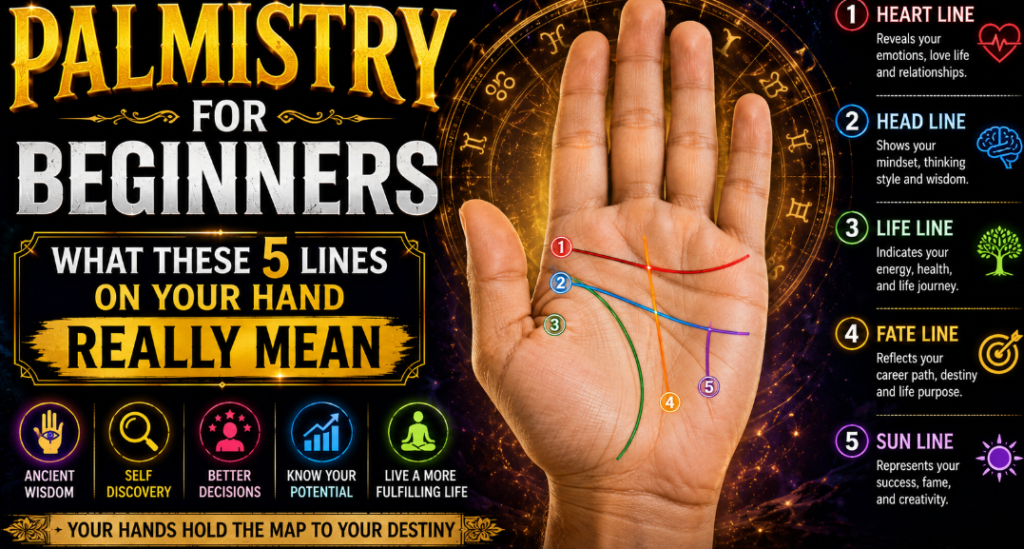
3. The Life Line – Not What You Think It Means
The Life Line is perhaps the most misunderstood line in palmistry. It curves around the base of the thumb in a semicircle toward the wrist. Contrary to popular belief, the Life Line does not predict how long you will live. This is a myth. What it actually reveals is your vitality, life energy, major life transitions, and the overall quality and enthusiasm with which you live your life.
- Long and deep Life Line: Robust physical energy, a zest for life, and strong resilience. You bounce back quickly from illness or setbacks.
- Short Life Line: Does not mean short life! It simply suggests that you prefer to live on your own terms and may be highly independent. Many long-lived people have short life lines.
- Faint or thin Life Line: You may need to pay extra attention to your physical health and energy management. This can indicate a tendency to take on too much mentally while ignoring physical wellbeing.
- Breaks in the Life Line: Major life changes — a relocation, a career shift, a health event, or a significant personal transformation. These are not necessarily negative — they simply mark chapters.
- Life Line with many small lines branching upward: Each upward branch indicates a period of positive growth, ambition, and achievement. Branches pointing downward can suggest energy lost to illness or draining situations.
A double Life Line (two parallel lines in the same position) is considered especially auspicious in Indian palmistry. It suggests strong life force, protection, or the presence of a guardian influence in your life.
4. The Fate Line – Your Destiny, Written in Your Skin
The Fate Line (also called the Saturn Line) runs vertically up the center of the palm from the wrist area toward the middle finger. Not everyone has a Fate Line — and that is perfectly fine. It simply indicates different things.
Having a strong, deep Fate Line means your life tends to follow a clear, defined path. You may have known your calling from a young age, or your life seems to unfold in an unusually purposeful way. People with very defined Fate Lines often feel a strong sense of life mission.
Having no Fate Line or a very faint one suggests that your life is more self-directed and fluid. Your path is built through your own choices rather than a preset destiny. This is not a negative sign — it suggests freedom and adaptability.
- Fate Line starting from the wrist (Mount of Luna): Strong public influence, popularity, and success dependent on others or the public. Common in politicians, entertainers, and public figures.
- Fate Line starting from the Life Line: Your early life was closely tied to family expectations. Independence came later in life.
- Fate Line starting mid-palm: Career and life direction became clear in your 30s or 40s. Late bloomers often have this marking.
Breaks in the Fate Line indicate major career or life changes. A break followed by a new line running parallel suggests a successful transition to a new path.
5. The Sun Line – The Mark of Success and Recognition
The Sun Line (also called the Apollo Line or Success Line) is a vertical line that runs toward the ring finger. Not everyone has this line clearly, and its presence is considered very auspicious in Vedic palmistry.
A clear, deep Sun Line indicates fame, recognition, creative success, and the ability to shine in public life. It does not guarantee wealth on its own — but it strongly suggests that whatever your field, you will be known and respected within it.
Many successful artists, writers, teachers, entrepreneurs, and public personalities have a prominent Sun Line. Even a short or partial Sun Line is positive — it shows periods of recognition and accomplishment.
When the Sun Line appears only in the upper section of the palm (near the ring finger), it suggests success that comes in the later stages of life. A Sun Line that starts from the wrist and reaches all the way to the ring finger indicates consistent recognition throughout life — a rare and powerful marking.
What About the Minor Lines?
Beyond the five major lines, palmistry also reads several minor lines that add nuance and detail:
- Marriage Lines: Small horizontal lines on the side of the hand below the little finger. They indicate significant relationships, not necessarily legal marriages.
- Health Line: Runs diagonally from near the little finger toward the Life Line. Reveals information about your digestive health and overall physical constitution.
- Travel Lines: Horizontal lines on the outer edge of the palm. Each line is traditionally associated with significant travel or major change brought about by movement.
- Intuition Line: A curved line on the outer palm, indicating heightened psychic sensitivity or strong intuitive abilities.
- Rahu and Ketu Lines: In Vedic palmistry specifically, certain markings correspond to the shadow planets Rahu and Ketu, indicating karmic influences.
The Mounts of the Palm – Reading Between the Lines
Palmistry is not only about lines. The fleshy raised areas at the base of each finger and on the palm — called mounts — are equally important. In Vedic palmistry, each mount corresponds to a planet and its qualities. A well-developed mount (raised and firm) amplifies that planet’s positive qualities in your life, while a flat or overdeveloped mount indicates imbalance.
The Mount of Jupiter (below index finger) relates to ambition and leadership. The Mount of Saturn (below middle finger) relates to discipline and karma. The Mount of Apollo (below ring finger) relates to creativity and fame. The Mount of Mercury (below little finger) relates to communication and business. The Mount of Venus (at the thumb base) relates to love, sensuality, and vitality.
How to Read Your Own Palm
Reading your own palm is a beautiful act of self-inquiry. Here is how to get started:
- Find good natural light and hold your hand at eye level, palm facing up.
- Start with the major lines: identify each line using this guide.
- Notice the quality of each line — deep, faint, clear, broken, chained, or forked.
- Compare both hands and note the differences.
- Journal your observations and reflect on how they resonate with your lived experience.
Remember: palmistry is a tool for self-awareness, not a rigid prophecy. The lines on your hand can and do change over time as you change. Many palmists have observed this — new lines appear, faint lines deepen, and breaks slowly heal as people grow and evolve.
Final Reflection: The Map Is Not the Territory
Your palm holds a map — but you are the one walking the territory. Palmistry offers a profound mirror for self-reflection: when a reading resonates, it invites you to understand yourself more deeply. When something does not seem to fit, it may be pointing to where you have the freedom and power to write your own story.
The ancient rishis who developed Hasta Samudrika Shastra understood something modern psychology has only recently begun to recognize: self-knowledge is the foundation of a well-lived life. Your hands know your story. Are you ready to listen?
Want a deeper reading? Explore our professional palm reading service at AstroFite.com and discover what your unique hand map is telling you about your path ahead.
Disclaimer: Palmistry is a traditional belief system used for self-reflection. It should not replace medical, legal, or professional advice.

Pratiksha Thakare is a Vedic astrology writer and spiritual researcher with deep study in Jyotish, numerology, and Hindu philosophy. She writes to make ancient wisdom simple and accessible for modern Indian readers.