
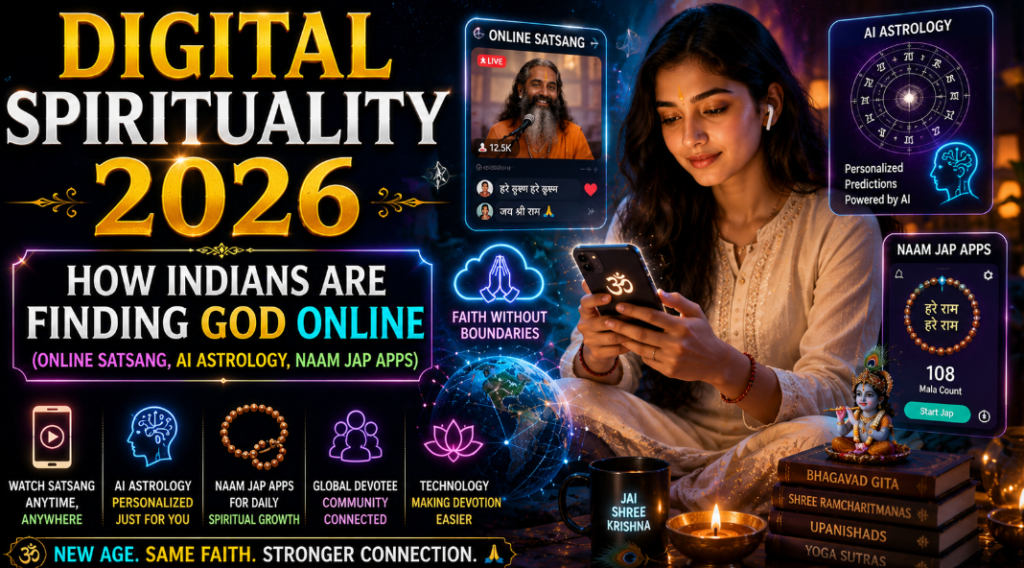
It is 6:45 in the morning in a small apartment in Nagpur. A young software engineer wakes up, opens her phone, and before checking WhatsApp or Instagram, she opens a naam jap app. The gentle chime of a bell rings. She taps the counter with each bead of her virtual mala. 108 times. Then she switches to a live-streamed morning aarti from Vrindavan, watches a Guruji’s discourse on YouTube, and checks her AI-generated Kundali update for the day — all before her morning chai.
This is not the future. This is 2026, and it is already the present reality for tens of millions of Indians.
The intersection of technology and spirituality — what sociologists are calling Digital Spirituality — is one of the most fascinating and rapidly growing movements in India today. A country where faith is woven into the fabric of daily life has naturally extended that faith into the digital realm. The result is a transformation that is reshaping how Indians pray, seek guidance, connect with their gurus, and experience the divine.
The Numbers Behind the Movement
To understand the scale of what is happening, consider a few data points from 2025-2026:
- India has over 820 million active internet users — the second largest online population in the world.
- Spiritual and religious content consistently ranks among the top categories on YouTube India, with devotional channels routinely crossing 10 million subscribers.
- The Indian wellness and spirituality app market crossed ₹3,000 crore in 2025 and is projected to grow at over 18% annually.
- During Navratri, Mahashivratri, and other festivals, spiritual live streams routinely see concurrent viewership in the millions across platforms.
- Search trends for terms like ‘online kundali’, ‘AI astrology’, ‘virtual puja’, and ‘naam jap counter’ have shown consistent year-on-year growth since 2021.
These are not niche numbers. Digital spirituality in India has become a mainstream phenomenon — and it shows no sign of slowing down.
Palmistry for Beginners – What These 5 Lines on Your Hand Really Mean
Online Satsang: The Community That Never Sleeps
Perhaps the most transformative development in India’s spiritual landscape has been the rise of online satsang — live-streamed and recorded spiritual discourses, bhajan sessions, and community gatherings.
What began as a pandemic-era necessity in 2020 has evolved into something much larger. Spiritual organizations like ISKCON, Art of Living, Isha Foundation, and dozens of independent spiritual teachers now maintain robust digital presences with daily live streams, recorded lecture libraries, and community forums.
But beyond the institutional players, the most remarkable story is that of independent spiritual content creators. A preacher in a small temple in rural Rajasthan can now reach devotees in Canada, the UK, and the UAE. A young sannyasi in Vrindavan who speaks simply and authentically can build a following of 500,000 YouTube subscribers — more reach than most established ashrams had in their first hundred years of existence.
Why Online Satsang Works
Several factors have made online satsang not just a substitute for physical gatherings, but often a preferred format for many seekers:
- Accessibility: No travel costs, no geographical limitations. A devotee in Pune can attend a satsang hosted in Mathura in real time.
- Flexibility: Recorded sessions can be watched at 3 AM, during a lunch break, or replayed as many times as needed.
- Community across distance: NRI Indians, especially in the Gulf, North America, and Europe, have found online satsang to be a powerful connection to their roots and spiritual community.
- Searchability: Devotees can now search for specific topics — ‘Bhagavad Gita Chapter 12 explanation’, ‘how to handle anger spiritually’, ‘what is maya’ — and find authoritative responses from their trusted teacher.
The challenge, of course, is discernment. The internet is also full of fraudulent ‘babas’ and misleading spiritual claims. Digital literacy in spirituality — the ability to evaluate sources, check credentials, and think critically — is becoming an essential skill for the modern devotee.
AI Astrology: When Ancient Wisdom Meets Artificial Intelligence
Of all the developments in India’s digital spirituality space, AI-powered astrology has been perhaps the most controversial — and also one of the fastest growing.
Traditional Vedic astrology (Jyotish) is an extraordinarily complex system. A full Kundali reading by an experienced Jyotish scholar requires analyzing the positions of nine planets across twelve houses, understanding their mutual aspects and conjunctions, calculating dashas (planetary periods), and interpreting all of this in the context of the individual’s life circumstances. It takes years of study and intuitive experience to do this well.
What AI astrology apps have done is democratize access to the basic framework of this knowledge — making it possible for someone to generate a detailed Kundali interpretation without waiting months for an appointment with a good astrologer, and without paying thousands of rupees for a consultation.
How AI Astrology Apps Work in 2026
Modern AI astrology apps in India are far more sophisticated than the generic ‘Sun sign horoscope’ apps of the 2010s. The best platforms today:
- Generate detailed Vedic birth charts using precise astronomical calculations based on your exact birth date, time, and place.
- Provide personalized dasha interpretations — explaining which planetary period you are currently in and what energies it typically activates.
- Offer AI-powered chat interfaces where users can ask specific questions and receive contextually relevant astrological guidance.
- Send daily or weekly personalized forecasts based on current planetary transits and their interaction with your natal chart.
- Match kundalis for marriage compatibility using traditional Ashtakoot matching systems.
Apps like AstroSage, mPanchang, and newer AI-first platforms have tens of millions of users. Even skeptics often find themselves checking their daily transit report ‘just out of curiosity.’
The Debate: Can AI Replace a Human Astrologer?
Among traditional astrologers, this question provokes strong opinions. The consensus among serious Jyotish practitioners is nuanced: AI can provide accurate raw chart data and decent generalized interpretations, but it lacks the ability to truly synthesize all variables, ask intuitive follow-up questions, understand the human context behind the data, or bring the lived experience that distinguishes a master astrologer from a competent technician.
Think of it like this: AI astrology is to a master astrologer what WebMD is to a cardiologist. Useful for initial orientation and general information, but not a replacement for the deep, personalized expertise of a human practitioner.
The sweet spot, which many platforms are beginning to explore, is a hybrid model: AI for instant, affordable basic readings and chart generation, combined with on-demand access to verified human astrologers for deeper consultations.
Naam Jap Apps: Devotion Goes Digital
Of all the digital spiritual tools available to Indians today, naam jap apps may be the most intimate and personally transformative. Naam jap — the repetitive chanting or counting of a divine name or mantra — has been a central practice in Hindu and Sikh devotion for millennia. The mala (prayer bead string) has traditionally been the tool for counting repetitions.
Today, a new generation of spiritual seekers is using digital jap counters — apps that replicate the mala experience on a phone, often with additional features like:
- Target setting (e.g., a commitment to 108 jap per day or a specific number over a 40-day sadhana period)
- Streak tracking to maintain daily consistency
- Community features where users can share their jap counts as a form of collective sankalpa (spiritual intention)
- Ambient sounds — temple bells, flowing river sounds, or soft bhajans — playing in the background during jap
- Completion certificates for significant milestones like 1,25,000 or 10,00,000 naam jap
Platforms like radhajap.in have pioneered this space for devotees of Radha Krishna, offering Jap counters specifically calibrated for Vaishnava sadhana traditions. The response has been enthusiastic: when devotional practice meets modern UX design, the barrier between intention and action collapses.
The Psychology of Digital Naam Jap
From a psychological perspective, what makes naam jap apps effective is the same mechanism that makes habit-tracking apps effective: visibility, accountability, and positive reinforcement. Seeing your daily count, maintaining a streak, and receiving a visual cue of completion activates dopamine pathways that reinforce the habit.
But something deeper is also at work. Bhakti teachers since the time of Chaitanya Mahaprabhu have emphasized that the nama — the divine name — carries its own spiritual potency independent of the chanter’s mental state. Even a distracted, unfocused jap session is not wasted. The name works on the consciousness like rain on a dry seed — slowly, consistently, inevitably.
Digital jap apps serve this teaching by removing one of the greatest obstacles to sadhana: the friction of starting. When your phone is already in your hand and the app is two taps away, the excuse of ‘I forgot my mala’ or ‘I’ll do it later’ becomes harder to maintain.
Virtual Puja and Online Darshan: Temples in Your Pocket
Another dimension of India’s digital spirituality revolution is the growth of virtual puja services and online darshan (temple viewing).
Major temples across India — including Tirupati, Siddhivinayak Mumbai, Shirdi, and Kashi Vishwanath — now offer live webcam darshan 24 hours a day, seven days a week. A devotee anywhere in the world can bow before their ishta-devata in real time, experience the aarti, and receive a digital prasad blessing.
Virtual puja services have gone even further. Several platforms now allow devotees to book specific pujas to be performed at temples on their behalf, for occasions like birthdays, anniversaries, Ekadashi observances, or during difficult life periods. A priest in Vrindavan performs the puja physically at the altar; the devotee receives video proof and a digital prasad certificate.
This has been particularly meaningful for Indian diaspora communities around the world — people who grew up with these rituals and temples as central to their identity but no longer have easy access to them.
The Challenges and Conversations Ahead
Digital spirituality is not without its tensions, and honest reflection requires acknowledging them.
- Authenticity: Is watching a live stream of aarti the same as being physically present at the temple? Most practitioners would say no — but many would say it is meaningfully better than no practice at all.
- Commercialization: As spiritual content becomes digital content, it inevitably enters the attention economy. The line between genuine spiritual teaching and engagement-optimized spiritual entertainment is sometimes thin.
- Misinformation: Fraudulent astrologers, fake babas, and misleading spiritual claims spread as easily online as accurate teachings. Seekers need discernment.
- Screen fatigue and spiritual practice: There is an emerging conversation in yoga and meditation communities about whether staring at a screen for spiritual practice undermines the goals of that practice — reducing anxiety, increasing presence, cultivating stillness.
These are real questions without easy answers. The tradition itself offers guidance: test every teaching against your own inner experience. Seek teachers who reduce your ego rather than inflate it. Measure your practice by the transformation in your daily life, not the sophistication of the app you use.
The Guru’s Transmission: What Technology Cannot Replace
Perhaps the most profound conversation in India’s digital spirituality discourse concerns the guru-shishya relationship. Traditional teachers from Ramana Maharshi to Nisargadatta Maharaj have emphasized that the real transmission of spiritual knowledge — the awakening of direct inner experience — happens through the living presence of a realized teacher. Shaktipat, darshan, satsang — these have traditionally required physical proximity.
Many digital teachers and their followers would contest this, pointing to experiences of profound spiritual opening during online sessions. The debate is genuinely unsettled, and probably depends heavily on both the teacher and the student.
What most traditionalists and digital innovators agree on is this: technology is a bridge. For the millions of people who would never have encountered genuine spiritual teaching without the internet — whether due to geography, economics, disability, or family circumstance — digital spirituality is an extraordinary gift. The risk is when the bridge becomes the destination.
Conclusion: Faith at the Speed of 5G
The spiritual journey has always adapted to its era. Bhakti saints composed songs for the masses when Sanskrit was inaccessible. Printing presses made scriptures available to ordinary households. Radio brought temple chants into city apartments. Television brought ashrams into living rooms.
The internet, AI, and mobile apps are simply the next chapter — and India, with its ancient spiritual traditions and its young, tech-forward population, is uniquely positioned to write this chapter with both authenticity and innovation.
Digital spirituality at its best does not replace the eternal — it makes the eternal more accessible. And in a world of increasing distraction, noise, and disconnection, that is not a small thing. That might, in fact, be exactly what this age requires.
Explore the intersection of ancient wisdom and modern tools at AstroFite.com — from AI-powered Kundali readings to Vastu Shastra guides designed for the 21st century home.
Note: All statistics cited reflect publicly available industry reports and app market research data from 2024–2025.

Pratiksha Thakare is a Vedic astrology writer and spiritual researcher with deep study in Jyotish, numerology, and Hindu philosophy. She writes to make ancient wisdom simple and accessible for modern Indian readers.