
In the vast and luminous calendar of Hindu observances, Ekadashi stands apart. Every fortnight, on the eleventh tithi of the lunar cycle, devotees across India observe this sacred fast — abstaining from grains, offering prayers to Lord Vishnu, and seeking spiritual merit. There are 24 Ekadashis in a regular year, and each carries its own unique significance.
But once in approximately two to three years, something rare happens. The Hindu calendar adds an extra month — Adhik Maas, also called Purushottam Maas or the leap month. And within this extraordinary month come two Ekadashis that exist nowhere else in the yearly cycle: Padmini Ekadashi and Paramā Ekadashi.
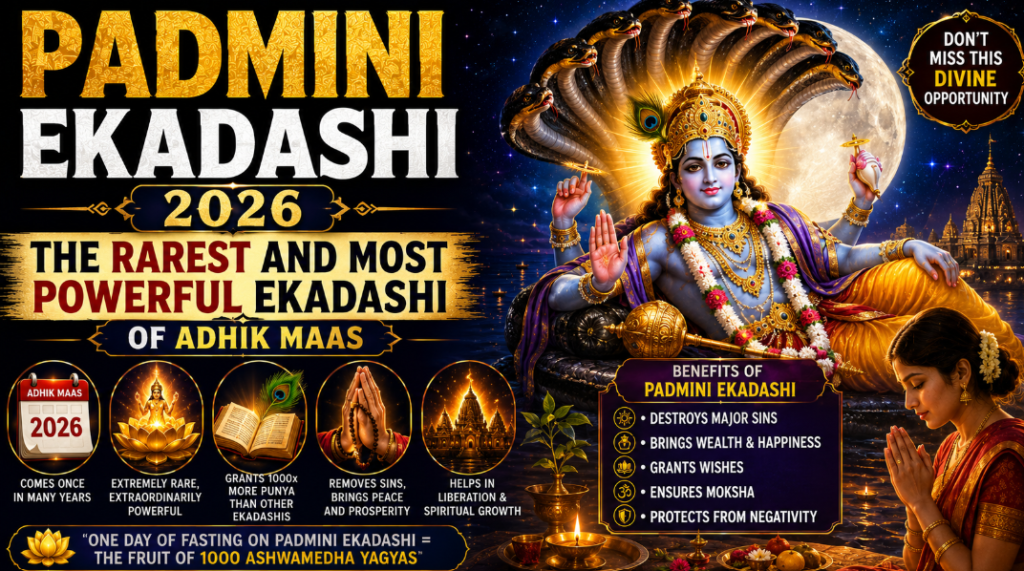
Of these two, Padmini Ekadashi holds a special place. Observed on the Shukla Paksha Ekadashi (the 11th day of the bright fortnight) of Adhik Maas, it is considered by many Vaishnava scholars and Dharmashastra texts to be among the most spiritually potent Ekadashis a devotee can observe. In 2026, Padmini Ekadashi falls on a particularly auspicious date — and the merit associated with observing it is said to be multiplied manifold because of the rare nature of Adhik Maas itself.
This article is your complete guide to Padmini Ekadashi 2026 — its date, timing, significance, fasting rules, the sacred Vrat Katha, and everything you need to observe this vrat with full devotion and knowledge.
Astrology App Industry in India 2026 – How a ₹1,300 Crore Market Is Changing Spiritual Life
Padmini Ekadashi 2026: Date and Tithi Timing
Padmini Ekadashi 2026 falls on 16th August 2026, Sunday, during the Adhik Bhadrapada Maas (the extra leap month falling between Ashadha and Bhadrapada in 2026 according to the Purnimanta calendar as observed in North India and various Vaishnava traditions).
Important timings for 2026 (approximate — please verify with your local Panchang):
- Ekadashi Tithi Begins: 14 August 2026, approximately 11:45 PM
- Ekadashi Tithi Ends: 16 August 2026, approximately 2:00 AM
- Parana Time (fast breaking): 17 August 2026, after sunrise — preferably between 5:30 AM and 8:00 AM
- Vrat Day: 16 August 2026 (the day when Ekadashi is active during sunrise is observed as the main vrat day)
Note: Tithi timings vary by region due to local sunrise and Panchang calculation methods. Always confirm with a trusted local Panchang or Hindu calendar for your city before observing.
What Is Adhik Maas and Why Does It Make Padmini Ekadashi So Special?
To understand the extraordinary significance of Padmini Ekadashi, you must first understand Adhik Maas.
The Hindu lunar calendar runs slightly shorter than the solar calendar — by approximately 11 days each year. To realign the lunar months with solar seasons, an extra month is periodically added, roughly every 32 months. This extra month is called Adhik Maas (the additional month) or Mala Maas (the defiled month) — because traditionally, most auspicious ceremonies like weddings, griha pravesh, and sacred thread ceremonies were NOT performed during this period.
But Adhik Maas is not spiritually barren. Far from it. According to the Puranas, the extra month was initially without a presiding deity, which caused it great sorrow. All the celestial months had a ruling deity, but Adhik Maas had none. When Adhik Maas approached Lord Vishnu with its grief, the Lord — in His infinite compassion — adopted it as His own. He declared that He, Purushottama (the Supreme Person), would be the deity of this month, and hence it was renamed Purushottam Maas.
From that moment, Adhik Maas became enormously auspicious. Any tapas, dana (charity), japa, or fasting done in this month is said to yield a hundred times more merit than the same action in a regular month. The Padma Purana states that the fruits of a lifetime of spiritual practice can be obtained through sincere devotion in Adhik Maas alone.
Padmini Ekadashi, falling within this uniquely powerful month, inherits all of this amplified spiritual energy. Observing it is not merely equal to a regular Ekadashi — according to scriptural testimony, it is an extraordinary opportunity that comes at most once in two to three years.
The Significance of Padmini Ekadashi in Scripture
The glory of Padmini Ekadashi is described in the Brahma Vaivarta Purana, in a conversation between Lord Krishna and King Yudhishthira. When Yudhishthira asks about the Ekadashi that falls in the bright fortnight of Adhik Maas, Lord Krishna responds:
“O Yudhishthira, this Ekadashi is called Padmini. It is extremely rare and the most beloved to Me among all Ekadashis of the extra month. One who fasts on this day with devotion and worships Me with lotus flowers, tulsi leaves, and a pure heart — I grant them liberation from the cycle of birth and death.”
The use of the name “Padmini” is itself significant. Padma means lotus — the symbol of purity, divine beauty, and spiritual awakening. The lotus grows in muddy water but remains untouched by it, much like a devotee who lives in the material world but keeps their consciousness anchored in the Divine. Observing Padmini Ekadashi is associated with cultivating this lotus quality — spiritual purity amidst worldly life.
The scriptures also state that the merit of Padmini Ekadashi equals the merit of performing a full Ashwamedha Yajna (horse sacrifice) — one of the most elaborate and powerful Vedic rituals — and yet it is available to anyone, regardless of caste, gender, or wealth, through simple fasting and devotion.
Padmini Ekadashi Vrat Rules – How to Observe It Properly
Dashami (The Day Before) Preparation
The vrat technically begins on Dashami, the day before Ekadashi. Devotees should:
- Eat a sattvic meal (no non-vegetarian food, no alcohol, no onion or garlic).
- Take a bath before sunset and worship Lord Vishnu.
- Avoid sleeping during the day, engaging in gossip, or speaking harsh words.
- If possible, sleep on the floor on Dashami night as an act of tapas.
On Ekadashi Day
The main vrat day rituals include:
- Wake up before sunrise (Brahma Muhurta — ideally between 4:00 AM and 6:00 AM).
- Take a bath and wear clean, preferably white or yellow clothes.
- Set up a picture or murti of Lord Vishnu or Lord Krishna for worship.
- Light a ghee diya (oil lamp) and incense. Offer tulsi leaves, lotus flowers, and yellow flowers if available.
- Chant the Vishnu Sahasranama, or any Vishnu mantra — “Om Namo Bhagavate Vasudevaya” is ideal.
- Observe a complete fast — no grains, lentils, rice, wheat, or flour products. Fruits, milk, curd, water, and certain roots (like sabudana) are permitted.
- Some highly devout observers perform nirjala vrat (complete abstinence from water) for maximum merit.
- Spend the day in prayer, reading scripture, listening to Vishnu Bhajans, and acts of charity.
- Stay awake through the night (jagran) if health permits — night vigil is especially auspicious on Adhik Maas Ekadashi.
Parana – Breaking the Fast
The fast is broken on Dwadashi (the twelfth day) morning, called Parana. This must be done during a specific time window — after sunrise but before the Dwadashi tithi ends. Eating during the correct Parana time is as important as the fast itself. Ideally, begin the Parana with a sip of water, chanting “Om Namo Bhagavate Vasudevaya”, then offer food to a Brahmin or a needy person before eating yourself.
Special Practices That Amplify the Merit of Padmini Ekadashi
Because Padmini Ekadashi occurs within the already magnified spiritual field of Adhik Maas, certain practices carry exponentially greater benefit:
Tulsi Seva: Watering the tulsi plant and offering her leaves to Lord Vishnu is considered especially auspicious. Avoid plucking tulsi on Ekadashi itself — offer leaves collected the evening before.
Nama Japa: Continuous repetition of the Lord’s name — whether “Hare Krishna Hare Rama”, “Om Namo Bhagavate Vasudevaya”, or simply “Vishnu Vishnu” — throughout the Ekadashi day is highly recommended. Even a committed 108 mala japa on this day carries exceptional merit.
Charity (Dana): Donating food, clothing, or money to those in need during Adhik Maas is said to yield merit equivalent to Tula Dana (donating gold equal to one’s body weight). Even modest charity done with sincerity is powerfully meritorious.
Reading the Vrat Katha: Listening to or reading the Padmini Ekadashi Vrat Katha — the sacred story associated with this day — is considered integral to the observance. It is available in the Brahma Vaivarta Purana.
Temple Visit: Visiting a Vishnu or Krishna temple on Padmini Ekadashi and participating in the abhishek or aarti is deeply beneficial.
Who Should Observe Padmini Ekadashi?
According to the scriptures, Ekadashi vrat is open to all — men, women, the elderly, and even children (with appropriate accommodations for health needs). The Padmini Ekadashi in particular is said to benefit:
- Those seeking relief from long-standing problems — financial, health-related, or relationship-related.
- Those who have accumulated negative karma and seek purification.
- Couples seeking harmony and a blessed marriage.
- Individuals on a spiritual path seeking liberation (moksha).
- Those who have lost loved ones and wish to offer merit for their souls.
The Puranas affirm that even an accidental or partial observance of Padmini Ekadashi yields significant merit — suggesting that the Lord’s grace on this day is especially accessible and generous.
A Word on Devotion Over Ritual
The most important element of Padmini Ekadashi is not the perfection of every ritual. It is the bhava — the inner feeling of surrender, love, and longing for the Divine. A simple fast observed with a pure heart, continuous remembrance of the Lord, and genuine compassion for others is worth infinitely more than an outwardly elaborate ritual performed without feeling.
As the Bhagavad Gita reminds us: “Whatever you do, whatever you eat, whatever you offer in sacrifice or charity, whatever austerity you perform — do it as an offering to Me.” Padmini Ekadashi is an invitation to live, even for one day, entirely in that spirit.
✦ Padmini Ekadashi 2026 falls on 16 August and occurs during the rare and supremely auspicious Adhik Maas. Observing this vrat with sincerity, fasting, nama japa, and devotion is said to yield merit equivalent to a lifetime of spiritual practice — an opportunity that comes only once in two to three years.

Pratiksha Thakare is a Vedic astrology writer and spiritual researcher with deep study in Jyotish, numerology, and Hindu philosophy. She writes to make ancient wisdom simple and accessible for modern Indian readers.