
If you had told someone in 2010 that astrology would one day be a ₹1,300 crore technology industry in India, they would have laughed. Astrology was the domain of the neighbourhood jyotishi, the family pandit, and the grainy television channels that ran 24-hour zodiac programmes. It was real, but it was offline, local, and largely invisible to the formal economy.
Fast forward to 2026, and the picture looks dramatically different. India’s digital astrology market has exploded into a full-scale industry, with venture-backed startups, celebrity astrologers with social media followings in the millions, AI-powered kundli tools, and subscription services that rival mainstream wellness platforms in user engagement.
Welcome to the new face of Indian spirituality — and it lives on your smartphone.
India’s Astrology Market: The Numbers That Define 2026
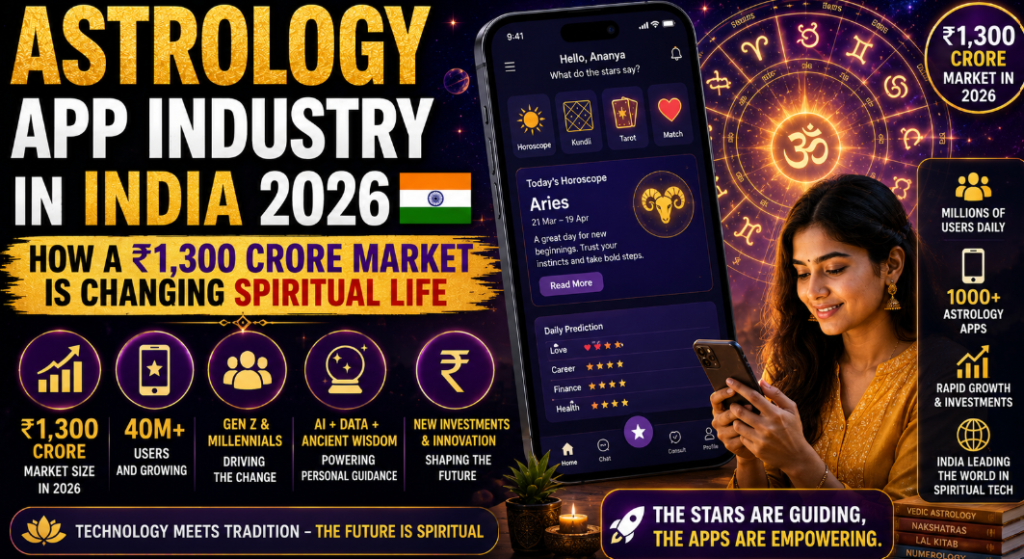
The Indian online astrology market is estimated to be worth over ₹1,300 crore in 2026 and is projected to grow at a compound annual growth rate (CAGR) of approximately 22% through 2030. To understand the scale of this, consider that India’s entire animation and VFX industry was only slightly larger just a few years ago.
Key statistics painting the picture:
- The Indian online astrology market was valued at approximately ₹1,070 crore in 2023, crossing ₹1,300 crore by 2026.
- Over 300 astrology-focused apps are currently listed on the Google Play Store targeting Indian audiences.
- AstroTalk, India’s largest astrology platform, reportedly crossed ₹500 crore in annual revenue by 2024, making it one of India’s most successful consumer-facing spiritual tech companies.
- Daily active users across the top 10 Indian astrology apps collectively exceed 15 million.
- The matrimonial astrology segment — kundli matching and compatibility — accounts for nearly 28% of total astrology app revenue in India.
- Tier 2 and Tier 3 city users now represent over 55% of astrology app downloads, driven by affordable smartphones and regional-language content.
These are not fringe figures. This is a market that has outpaced several traditional consumer tech segments in growth rate, and it shows no signs of slowing.
Astrology for Gen Z Indians – Why 60% of Young People Are Turning to Zodiac Signs for Life Decisions
Who Are the Key Players Shaping the Market?
AstroTalk
Founded by Puneet Gupta in 2017, AstroTalk is India’s undisputed market leader. The platform connects users with verified astrologers via chat, call, and video. Its model — a marketplace where qualified astrologers set their own consultation rates — has disrupted the traditional guru-client relationship by giving both sides more control and transparency. With over 100 million registered users and a catalogue of thousands of astrologers, AstroTalk is essentially the Practo of spiritual guidance.
mPanchang
One of India’s oldest digital astrology platforms, mPanchang has built its dominance on the bedrock of tradition — daily panchang, tithi, muhurta, and festival calendars. It has quietly amassed over 20 million monthly users who turn to it for auspicious timing for everything from surgeries to home purchases.
Astrosage
Known for its comprehensive Vedic kundli tools, Astrosage remains a favourite among astrology students and serious practitioners. Its free kundli generator is among the most visited pages in Indian spiritual content, driving massive SEO traffic that sustains its advertising and premium service model.
Astrofite and the New Wave
A growing number of newer platforms like Astrofite.com are carving out space by focusing on content quality, SEO-driven discovery, and niche topics — transit forecasts, numerology, and spiritual lifestyle content — targeting the underserved gap between entertainment astrology and serious Vedic analysis. These platforms are increasingly important for organic, community-driven growth.
What Services Are Driving Revenue?
The astrology app economy in India has diversified far beyond simple horoscope readings. Today’s revenue streams include:
Live Astrologer Consultations: The largest and fastest-growing segment. Users pay per minute (ranging from ₹5 to ₹500/min depending on the astrologer) for real-time consultations via chat, audio, or video.
Kundli and Birth Chart Analysis: Automated kundli generation is often free, but detailed manual interpretation reports — covering career, marriage, health, and wealth — command premiums of ₹299 to ₹2,499 per report.
Gemstone and Remedy Sales: A highly lucrative segment. Platforms recommend specific gemstones, rudraksha beads, and yantras based on kundli analysis and earn significant commission from marketplace sales.
Subscription Plans: Monthly and annual memberships offering priority access to astrologers, detailed daily forecasts, and exclusive transit reports are increasingly popular.
Matrimonial Compatibility: Kundli matching services integrated with matrimonial platforms like Shaadi.com and Jeevansathi represent a sticky, high-intent monetisation channel.
AI-Powered Auto-Readings: The newest entrant. AI tools that generate personalised horoscope interpretations at scale — without human astrologers — are allowing platforms to serve millions of users at near-zero marginal cost.
The Technology Driving the Boom
The astrology app industry’s rapid growth is inseparable from its smart adoption of technology. Several innovations are proving particularly transformational:
Artificial Intelligence and Machine Learning
AI is being used to generate personalised daily forecasts, power chatbot-based initial consultations, and match users with the right astrologers based on past session feedback. Some advanced platforms are training models on thousands of historical kundlis to identify predictive patterns — an approach that blurs the boundary between astrology and data science in fascinating ways.
Voice and Regional Language Support
The decision to build voice-first and Hindi-first (and then into regional languages including Tamil, Telugu, Bengali, and Gujarati) has been one of the most important strategic moves in the industry. It opened the market to hundreds of millions of Indians who were previously excluded from digital spiritual content.
WhatsApp and Notification-First Engagement
Many astrology platforms have built their retention strategy around WhatsApp — sending daily panchang updates, personalised transit alerts, and special day reminders directly to users. This low-friction touchpoint drives extraordinary daily engagement without requiring users to open an app.
How the Industry Is Changing Spiritual Life in India
The deeper story here is not just economic. The rise of the astrology app industry is fundamentally reshaping how millions of Indians engage with spirituality.
Democratisation is the most significant shift. In the pre-app era, quality astrological guidance was available only to those who could physically access reputed astrologers — often in big cities, often expensive, and often gatekept by social networks. Today, a woman in a small town in Uttar Pradesh can consult a Kolkata-based astrologer with a 4.8 rating and 10,000 reviews for ₹30 per minute. This is genuinely revolutionary.
Disintermediation is another major change. Local pandits and family astrologers who once monopolised astrological knowledge are increasingly bypassed by users who prefer the anonymity, variety, and price transparency of apps. Some traditional practitioners have adapted by joining these platforms; others are struggling.
The commercialisation of spiritual guidance also raises ethical questions. When astrology becomes a marketplace with ratings and reviews, what happens to the guru-shishya relationship? Are users getting better guidance — or simply more convenient access to varying quality? These are conversations the industry is only beginning to have.
The Road Ahead: What to Expect by 2030
Several trends will define where India’s astrology app industry goes next:
- AI astrologers that can deliver 90% of the guidance a human astrologer provides, at a fraction of the cost, will become mainstream.
- The integration of astrology with mental health and wellness platforms will deepen, as the market recognises the emotional support function astrology already plays.
- Export markets — particularly the Indian diaspora in the US, UK, Canada, and the Gulf — will become major growth drivers, with platforms building English and multilingual interfaces for global reach.
- Regulatory frameworks for astrology services may emerge as the industry grows large enough to attract government attention to consumer protection issues.
- Gamification — daily challenges, streak rewards, spiritual quests — will be used more aggressively to drive retention.
India’s astrology app industry has already crossed the point of being a curiosity. It is now an infrastructure for spiritual life — as embedded in the daily routine of millions of Indians as their news apps and banking apps. That is a remarkable transformation, and it is just getting started.

Pratiksha Thakare is a Vedic astrology writer and spiritual researcher with deep study in Jyotish, numerology, and Hindu philosophy. She writes to make ancient wisdom simple and accessible for modern Indian readers.